
Azure is clearing out a long list of services over the next six weeks. Most of them are older API versions and first-generation AI services, but two are the kind of thing that runs quietly in production for years without anyone thinking about it.
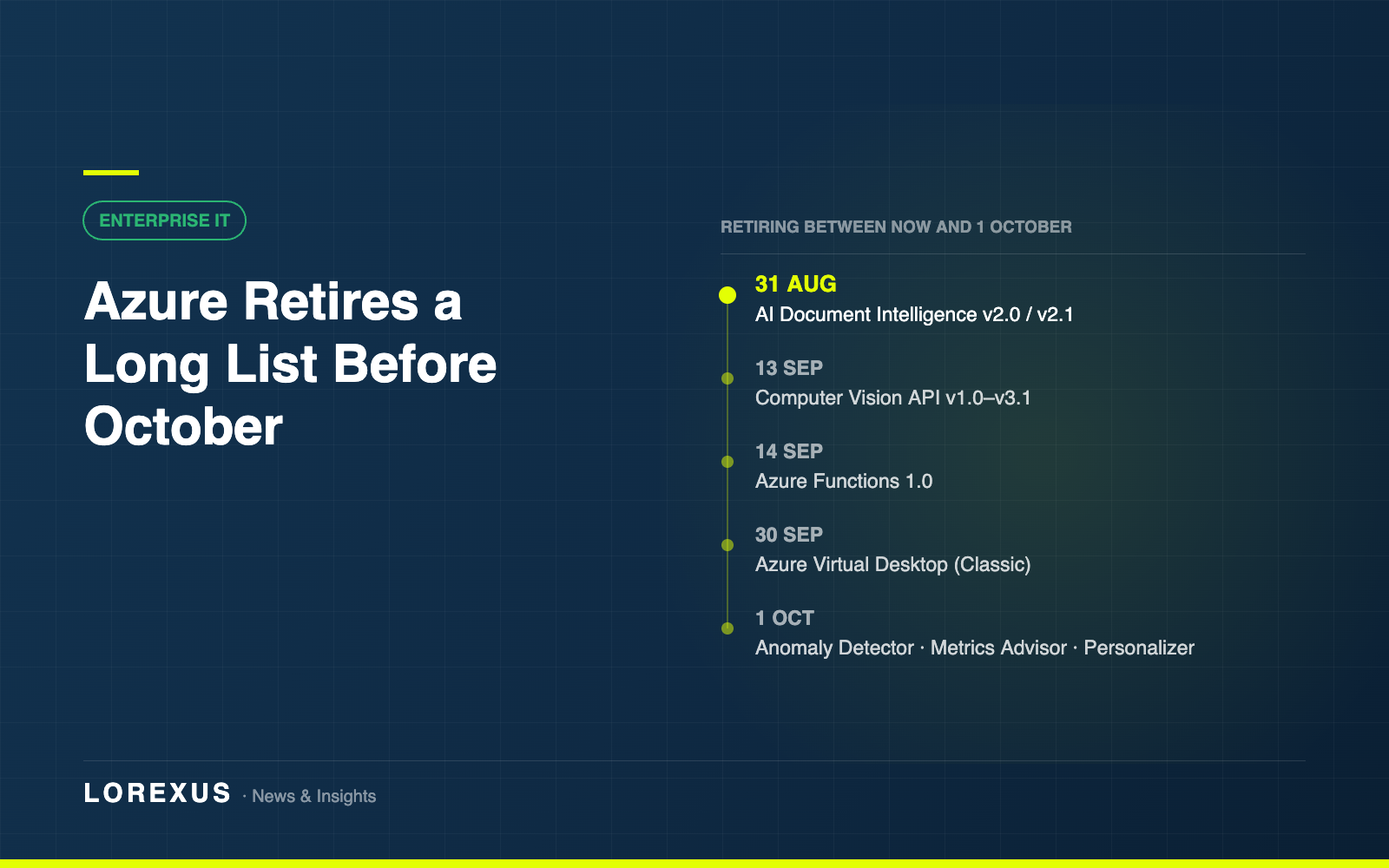
The dates, in order:
31 August — Azure AI Document Intelligence v2.0 and v2.1
The v2.0 API and the v2.1 container both retire. If you built a document-processing pipeline against these, it stops working. This is nine days away, which makes it the only item on this list that is genuinely urgent rather than merely important.
13 September — Computer Vision API v1.0 through v3.1
Every version from v1.0 to v3.1 retires on the same day. Anything still calling those endpoints needs to move to the current Azure AI Vision APIs.
14 September — Azure Functions 1.0
The original Functions runtime reaches retirement. Version 1.0 apps are typically old, small and forgotten — a scheduled job someone wrote years ago that has run without complaint ever since. Those are exactly the ones that will not be on anybody’s migration list.
Worth running an inventory across subscriptions rather than trusting memory here.
30 September — Azure Virtual Desktop (Classic)
The big one for most estates. AVD Classic — the pre-ARM deployment model, managed through PowerShell rather than the Azure portal — retires at the end of September. Anything still on Classic needs to be on the ARM-based Azure Virtual Desktop before then.
Organisations that deployed AVD early and never revisited the architecture are the ones affected. If your AVD was set up in the last few years through the portal, you are already on ARM and this does not apply.
30 September — Azure API for FHIR and Azure FXT Edge Filer
Azure API for FHIR retires in favour of the FHIR service in Azure Health Data Services. The FXT Edge Filer hardware appliance also reaches retirement. Both are narrow, but if they apply to you they apply completely.
1 October — Anomaly Detector, Metrics Advisor and Personalizer
Three first-generation Azure AI services retire on the same day. There is a pattern worth noticing here: Microsoft is steadily retiring the standalone, single-purpose AI services from the Cognitive Services era and consolidating capability into the Foundry and Azure AI platform. If your architecture depends on one of these narrow services, assume the others are on the same trajectory.
Also worth noting
Azure Maps Render V1 retires on 17 September, and the Azure Maps Web SDK v1.x and v2.0–v2.0.32 retire across 19–30 September.
What to do this week
Document Intelligence first, because it is nine days out and everything else has at least three weeks.
Then run an inventory rather than a recollection. Functions 1.0 apps and AVD Classic deployments share a characteristic: they work, so nobody thinks about them. A subscription-wide check will find things that a conversation will not.
Then check ownership. Several of these will belong to a supplier, an agency or a former employee rather than to your own team. Finding that out on 29 September is a worse experience than finding it out now.
Dates here are taken from Microsoft’s published lifecycle documentation. Retirement dates do occasionally move, so confirm against the individual service’s retirement page before you plan work around one.